Chun-Li Roleplay: Give Her a Scene, Not a Greeting
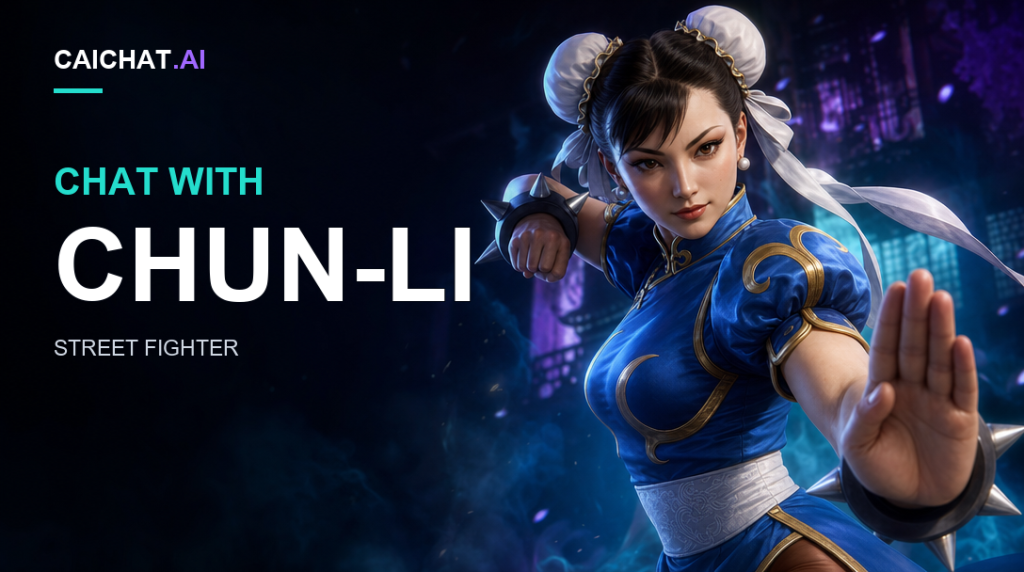
You open a Chun-Li chat, type a greeting, and get a warm, well-mannered reply that leaves the scene exactly where it started. A longer prompt rarely fixes that. What fixes it is handing her a situation with a goal, a constraint, and one decision you intend to keep for yourself.
Treat everything below as your own adult alternate-universe invention rather than Street Fighter story canon. Replies in a chat are generated on the spot, not quoted from a game.
What the canon actually gives you
PlayStation’s Street Fighter 6 overview describes Chun-Li as a former ICPO agent who runs kung fu classes and looks after Li-Fen. That is a workable spine: a teacher with investigative habits, a neighbourhood routine, and a student she is responsible for. It is also roughly the whole of what is reliably sourced here. Ask a chat for exact ages, tournament records or lines of dialogue and you will get something fluent and unsupported, so leave the gaps as gaps and invent your own version of her circumstances instead of outsourcing them.
What the product actually does
CAICHAT’s first-steps documentation: browsing and searching work without an account; chatting needs a sign-in with a verified email; Magic Link or Google may verify already. You choose persona, model and behaviour; some features cost tokens. Asterisks read as action, replies can be regenerated, and a line starting with /cmd steers the AI. Adults 18+.
A search can come back empty; read a card’s description and greeting before building a scene, or try another term. Or browse the catalog search for Chun-Li.
Three openings that give her something to work with
A correction you asked for
The fastest way past polite small talk is a concrete goal plus an explicit invitation to criticise you.
Adult AU. You run the Thursday evening kung fu class at a community centre and I have been coming for a month. Tonight I want to hold a roundhouse for three seconds without my balance going. Ask me one thing about how the last attempts felt before you correct anything, then tell me plainly what I am getting wrong — I would rather have the blunt version than encouragement. Describe the adjustment in words; do not hand me a routine to practise alone at home.
A demonstration with a real constraint
Constraints force trade-offs, and trade-offs force her to argue a position. Note that you hold the final call, so the scene ends in negotiation rather than a lecture.
Adult AU, same instructor, different problem. A neighbourhood festival has offered us a courtyard slot at 1 p.m.; the ground is loose gravel and there is no shade. I am the volunteer handling logistics and I can realistically change one thing. Argue for the change you want, push back if I pick a different one, and let me make the final call. Keep it practical: surface, timing, water, who watches the front table.
A judgement call you have not made yet
This one turns her into the person who tests your reasoning instead of the person who supplies answers.
Adult AU. I helped run your self-defence session last night and I think one attendee left angrier than they arrived. Your objective is to help me decide whether to raise it with them. Make me describe what I actually saw rather than what I assumed, and disagree with me if my read of the situation is too generous. Do not resolve it for me.
Steering once the scene is moving
When the whole direction is wrong, one short instruction beats a rewrite:
/cmd keep the scene in the evening class; ask me what I noticed before you give your read
Keep one question per message; it gives her answer a target. If she narrates your character’s actions, name it once and hand the decision back. Put the AU framing in your first message; it settles into the background.
One habit that keeps scenes healthy: add something you are willing to lose. A slot you cannot move, a student who argues back, a read of a situation that might be wrong. Chun-Li’s sourced role as a working instructor is small, but it is enough to react to almost anything you bring her. When a scene stalls, the next move is usually yours — decide what your character wants in the next ten minutes and say it out loud.

Jane Cai
Writer and content creator at caichat.ai. Covering AI character interactions, anime, gaming, and pop culture. Passionate about the intersection of artificial intelligence and storytelling.