How to Roleplay with Charlotte Katakuri in a Chat
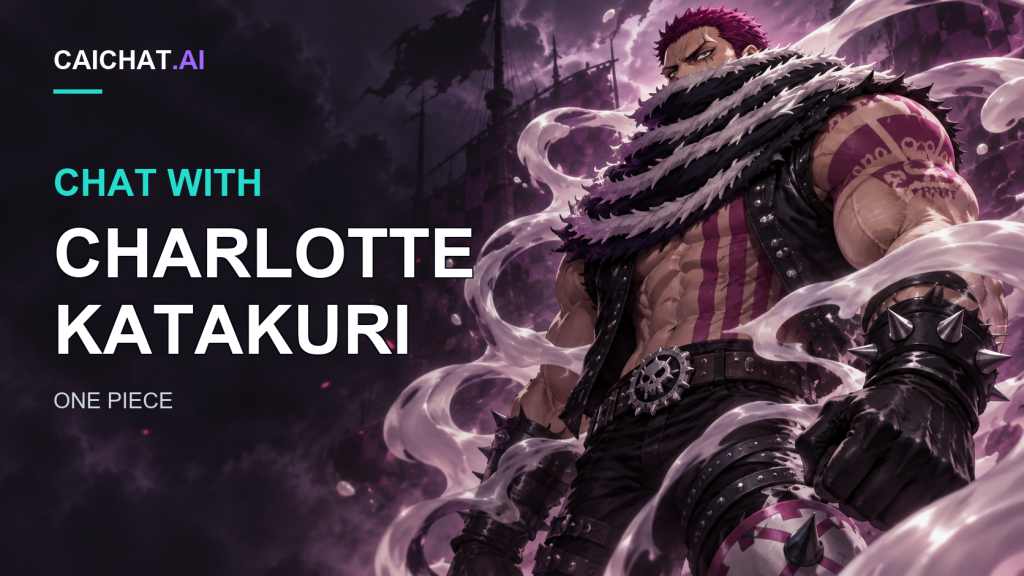
You type hey Katakuri into an empty chat, get three polite sentences and a question about your day, and close the tab. The blank prompt is usually the problem. A character with no job, no stake and nothing to defend has nothing to push against. Give him a role, a decision and a reason to stay reserved, and the same opener turns into a scene.
What the chat does before you write anything
CAICHAT is for adults 18+. Browsing and search are account-free; chatting requires sign-in and a verified email, which Magic Link or Google may already cover. You choose the persona, model and behavior; some features cost tokens. Asterisks mark actions, replies can be regenerated, and a /cmd line steers the next reply. See the first-steps documentation.
Who Charlotte Katakuri is in the catalog
Charlotte Katakuri appears in One Piece; the Toei Animation character index confirms the name and the series. That index says nothing about how he talks or what he wants, so everything past the name comes from the version you build yourself — from what you know of the series and from the choices you write into the prompt.
Decide the voice before you type a line
A reserved reading gives you more to react to than a chatty one that explains everything, but it only holds if you set it at the start. With no instruction, most models default to friendly and helpful, then your corrections arrive one reply too late. Write the rules into the opening prompt instead.
Keep each reply to one or two sentences. No exclamation marks. Ask me a question only when you actually need an answer, and let me carry the conversation.
Treat eagerness as a signal to steer. If a reply comes back faster or warmer than the scene needs, regenerate it, or name what was off and let the next line absorb the correction.
Three openings with a decision inside
Everything below is original and noncanonical, set in an adult alternate universe where you and your character are adults; you can decline, end or redirect any of it at any point. Each prompt hands the other character something to want and leaves the next move with you.
A bakery collaboration
Two adults with different standards, one afternoon to agree on a shared menu, and one component that is not quite right. The decision is whose name ends up on the finished piece and whether the batch waits.
Adult AU. You run a bakery and I’m the chocolatier you’ve agreed to test a shared menu with. We have one afternoon. Play Katakuri as the person who owns the standard: reserved, precise, comfortable saying no. Tell me what you would change about my component first, then ask me one question and wait for my answer instead of deciding for me.
A friendly sparring match
Two adults agree on rules before anyone throws a punch. The decision is what stops the bout — a word, a raised hand, or one of you calling it.
Adult AU. We’re sparring partners meeting for a friendly match, and neither of us is trying to hurt the other. Before we start, you set the ground rules: the signal to stop, how hard we go, and what happens if either of us wants out. Play Katakuri as economical with words and unwilling to fill silence. Open with the first rule and let me add mine.
A trail decision
Two adults on a hike, the weather turning, two hours from the trailhead. The decision is yours: push on or turn back, and whether you say it out loud.
Adult AU. We’re hiking partners, two hours from the trailhead, and the weather is getting worse. You’re the steadier one. Don’t tell me what to do — give me the single observation that makes the call mine, then wait. If I say we turn back, accept it without arguing.
Steering when a scene drifts
Name constraints, not moods. A /cmd line with a concrete instruction changes the next reply; a request for a vibe rarely does. Save it for the moments when the scene needs to turn mid-conversation.
/cmdStay in the bakery scene. I’m still deciding about the recipe. One sentence, and don’t ask me anything this turn.
Watch for replies that decide for you, narrating what you say, feel or agree to. Correct those the same way. The character can want things; the next move stays yours, and you can drop a scene whenever it stops being interesting.
Finding him in the catalog
Search the catalog for Charlotte Katakuri and read the card’s description and greeting. Those two fields say more about how a specific character is written than the title does. Catalog entries change, so a blank result is normal: try the surname on its own, try One Piece, or loosen the spelling. If nothing turns up, the prompts above still work with any reserved character you do find.
Most flat chats fail on setup rather than wording. Give the character work to do, a standard to defend and a reason to hold back; keep your own lines short; and when a reply arrives too smooth, cut your next prompt in half and hand him a decision instead of a description.

Jane Cai
Writer and content creator at caichat.ai. Covering AI character interactions, anime, gaming, and pop culture. Passionate about the intersection of artificial intelligence and storytelling.