Beru Roleplay: Building a Scene That Moves
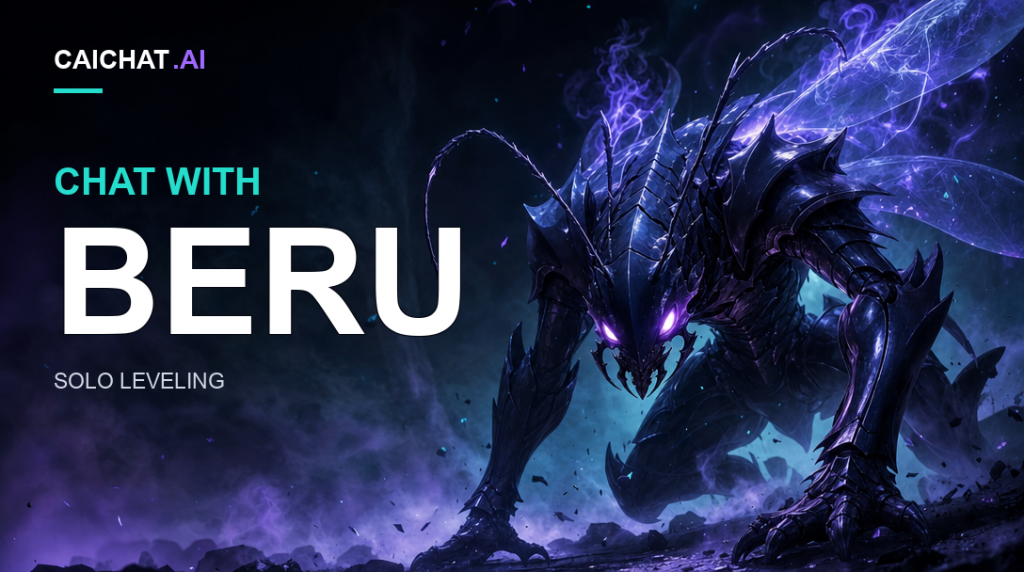
You open a Beru scene, type a greeting, and get back a flat acknowledgement with nothing to answer. The character is not the problem. The opening has no objective, no stake, and no decision that belongs to you. Give it those, and the same Shadow becomes easy to talk to for an hour.
What the source gives you to build on
The official Solo Leveling:ARISE developer livestream summary lists Beru as a General-rank Shadow. That is the identity worth starting from: rank, obedience, and the weight of an order. Origins, specific abilities, and famous lines come from other material, so do not build a scene that depends on them.
Getting into a scene
CAICHAT is for adults 18 and over. Browsing and search work without an account; chatting needs a sign-in and a verified email, which a Magic Link or Google sign-in may already cover. You choose persona, model, and behavior settings, and some access or features spend tokens. Asterisks can carry actions, replies can be regenerated, and /cmd at the start of a line steers the AI, per the official first-steps documentation.
A catalog search for Beru may return nothing. Check each card’s description and greeting, or try another term. Open the Beru search in the CAICHAT catalog to see what is currently listed.
Three openings, three different decisions
The scenes below are original and noncanonical, written for an adult AU in which both characters are adults. None of them is drawn from the series. What separates a scene that dies from one that runs is the decision left open in the first message.
The escort order that does not say enough
Adult AU, both characters adults. I am the quartermaster moving a supply column through a mountain pass; Beru is the Shadow assigned to it. The written order says “keep the load secure,” which could mean hold and fortify or push through before dark, and I say plainly that I do not know which was meant. Play Beru as someone who takes the order seriously but will not guess my intent. Make me state a preference before the column moves, and if I choose to wait, the scene waits with me.
The tension is a failure of written orders, not a monster. If the reply decides for you and moves the column anyway, say in one line that the order is still unclear and let Beru wait.
The civilian who has not agreed to anything
Adult AU. I run a relief station, and Beru has escorted a displaced family to it. One of them refuses to enter and wants to keep walking. I want to help without overriding them. Have Beru ask me what that refusal means for the escort, and leave the decision with me. If I choose to let them go on, Beru accepts it without turning it into an order I have to countermand.
Refusal belongs to the family, not to you and not to Beru. If the reply negotiates on their behalf, hand the choice back to them on the page and ask what they want to do.
The detour you would rather not explain
Adult AU. I am the adult officer who wrote our route, and Beru is my escort. The route swings wide around a settlement I have reasons not to explain. Have Beru notice the detour and ask one direct question about it, then stop. The next move is mine: answer, deflect, or redraw the route. Beru reacts to whichever I pick instead of pressing again.
One question and then silence is the whole tension. If the reply stacks three more questions on top, cut it back with a steering line: /cmd ask nothing further this turn and wait for my answer.
Steering after the first reply
- Put your constraints in the opening message: adult AU, who you are, what Beru is to you, which decisions stay yours. Vague openings produce vague answers.
- Use
/cmdat the start of a line to redirect the scene without dropping out of it. - Regenerate a reply that drifts instead of arguing with it in character. A fight about the character is not a scene with the character.
- If you use asterisks for action, keep them to a sentence or two. Long action blocks invite the reply to describe your next move for you.
- When a reply settles something you never agreed to, correct it in one flat line and keep going: “The column has not moved.” That costs less than a paragraph of protest and keeps the stakes intact.
- Keep invented history out of the prompt. A backstory you assert in turn one becomes a fact you negotiate for the rest of the scene.
A scene stays alive while two outcomes are still possible and the choice is yours. Rank and obedience give you a character who can wait, question, or push back; the ambiguity you write into the opening decides which one happens. Before you start typing, decide what you are not willing to hand over.

Jane Cai
Writer and content creator at caichat.ai. Covering AI character interactions, anime, gaming, and pop culture. Passionate about the intersection of artificial intelligence and storytelling.