How to Steer a Chat with Imu
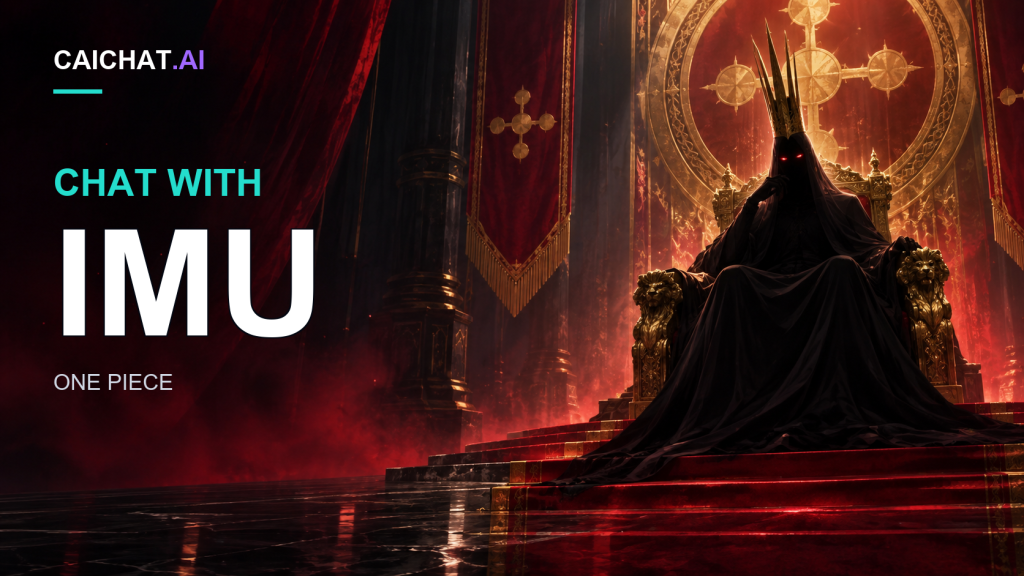
You ask for Imu and get a generic monarch: a deep voice, a vague threat, one reference to a throne. The problem is rarely the character. It is usually a prompt that asks Imu to perform authority instead of giving you something to react to.
The World Government of One Piece is, in the series’ account, secretly headed by Nerona Imu, seated above the Empty Throne. That is the solid ground: hidden supreme authority, and the throne. Everything else fans argue over — powers, appearance, history, motive — is unstated or unresolved, so treat it as your invention rather than a reference point. The Wikipedia overview of the World Government is the starting point.
Setup before your first line
The catalog browses without an account; chatting needs a sign-in with a verified email, and a magic link or Google sign-in may already have covered the verification. The site is for adults. You can choose persona, model and behavior, some options cost tokens, text in asterisks reads as action, replies can be regenerated, and a line beginning with /cmd steers what the AI does next. Search results vary, so read a card’s description and greeting before you commit, and try another spelling if Imu comes back thin. The mechanics are documented on CAICHAT’s first-steps page.
Want to see what is listed? Open the Imu search results in the character catalog.
Prompts that give Imu a decision
Name who you are, where you are, what you want, and what you will do if you do not get it. Characters who hold authority are easiest to play when your character is asking for something specific: a ruling, a record, an answer. Vague prompts get vague power. Skip variations of tell me who you really are, too — a character built on secrecy can only deflect that. Hand over a concrete problem and let the reply reveal as much as it wants to.
Three openings, three different choices
These scenes are invented, not canon, and all of them run as an adult alternate universe with an adult character of yours. Change the room, the names and the stakes to fit what you want to play.
The archivist who has not looked up
I am an adult archivist alone in the palace records room at night, copying ledgers I was told not to read. The door opens behind me. I do not turn around. You can stay silent, take the ledger, or ask me something — I decide whether to close the book or keep writing. Keep your first reply to two sentences and do not explain your reasons yet.
The choice on the table is whether your character breaks the silence or holds it. If a reply starts narrating what your archivist feels or does, regenerate, or use /cmd to keep it on its own side of the desk.
Two advisors and a guest list
I am the newer advisor, standing in the antechamber for the first time. You are the veteran: decades of service, firm opinions about who stands where, who bows first, and which courtesies are really about power. We are arguing over a guest list. Press me with specifics — order of entry, titles, distance from the door — and concede one point before we are interrupted.
Here you are choosing whether the argument escalates or stays procedural. If it slides into threats, that usually means your last message did; pull it back with a concrete detail, such as who carries the list into the room.
The envoy with bad news
I have just returned from a long voyage to report that a distant kingdom has stopped sending tribute, and I want a decision before I sit down. I will give you the facts in order and stop when I am done. Interrupt once with a question. Then tell me what you would do — and I will push back if the cost is higher than I think the result is worth.
The decision belongs to you here, not to the character. Accept the counsel, argue it down, or leave without an answer; all three keep the scene moving.
When a reply goes flat
Long speeches from a distant ruler sound impressive and do nothing. A short command fixes the tone faster than editing the reply by hand.
/cmd answer in one short paragraph, no more than three sentences, and end with a question for me.
Regenerating is the other lever. If a reply gets the voice right and the position wrong, ask for another instead of arguing with the one on screen. Do not count on a detail from twenty messages back surviving on its own — restate the constraint you care about in your next turn. And if the character keeps spilling secrets it should not, that is often your prompt leaving it nothing else to do.
Pick the scene where you already know what your character will do if refused, because that is the moment worth writing toward. The tone, the titles, even whether the throne comes up at all, you can adjust as you go.

Jane Cai
Writer and content creator at caichat.ai. Covering AI character interactions, anime, gaming, and pop culture. Passionate about the intersection of artificial intelligence and storytelling.