Roleplaying With Johnny Silverhand: Give Him Something to Argue
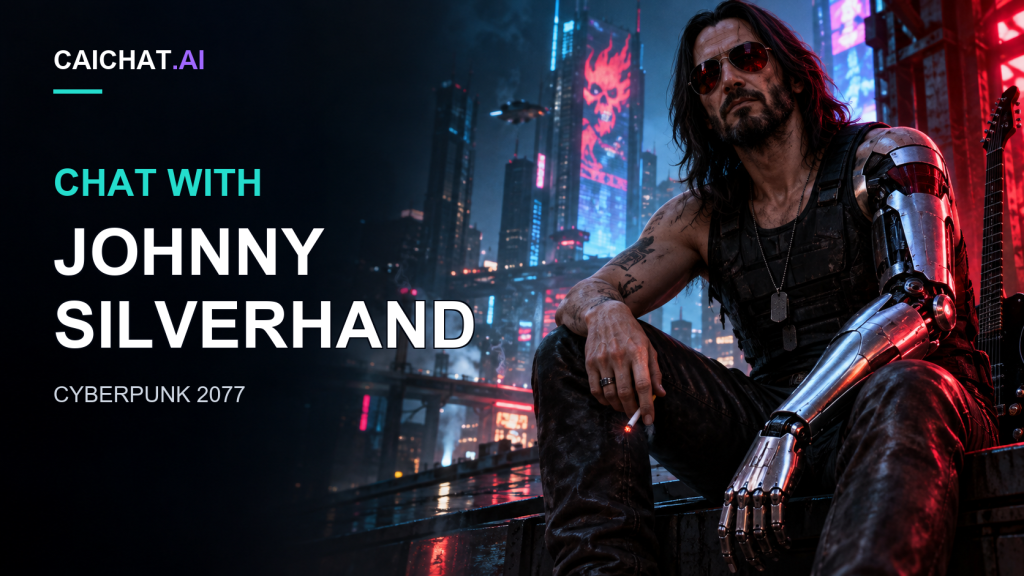
You want friction: Johnny Silverhand arguing with your pitch instead of agreeing with every line you write. That rarely comes from a longer prompt. It comes from handing him a stake, a deadline and a reason to say no — and from knowing which parts of him you are making up. The scenes below show how that works in practice.
What the fiction actually gives you
Johnny Silverhand is one of Night City’s most iconic figures, the frontman of the chrome-rock band SAMURAI, and a rockerboy — the term the official Cyberpunk 2077 site uses. That is the documented core: a performer with a public voice. Where he is, who he has met, what he wants on a given evening, you supply. Lean on the posture rather than on plot beats, and you avoid spending the scene on story you would rather not have spoiled.
What the chat tool does
CAICHAT is for adults 18+. Browsing and searching the catalog work without an account; sending messages needs a sign-in with a verified email, and a Magic Link or Google sign-in may handle that step for you. You pick a persona, model and behavior settings, and some options cost tokens. Actions written in asterisks read as narration, replies can be regenerated when one falls flat, and /cmd at the start of a line steers the AI directly. The official first-steps documentation lists these mechanics.
Availability is not guaranteed: a catalog search for Johnny Silverhand may return several cards, one, or none. If nothing shows up, shorten the search term, and read each card’s greeting and description before you commit to a scene.
Two scenes to open tonight
Both are my invention, not game canon: an adult alternate-universe setup in which you play an adult character of your own making. Keep the AU tag in your first message so the scene has a floor to stand on.
Scene one: the interview you have not landed
You: an adult music journalist. He: the subject who has not agreed to anything yet. Objective: leave with something usable about a hypothetical SAMURAI reunion without handing him editorial control. Tone: clipped and professional from you; he decides how much courtesy to return. Your choice: push when he deflects, or back off and keep the door open.
AU, adult: in this version of Night City the reunion never happened. I’m an adult music journalist, two days from a print deadline, one interview slot left. You’re Johnny. Decide whether my pitch is worth your time and tell me your terms. I’ll decide how hard to push when you say no.
What gets tested here is the negotiation, not the quotes. Give yourself something to lose — a magazine that will run the piece either way, a rival who already published something he hated — and the exchange carries weight instead of melting into agreement.
Scene two: the hour-a-day problem
You: an adult guitar student. He: the person you asked to keep you honest. Objective: a two-week practice plan. Tone: blunt and impatient, not cruel. Your choice: accept the plan as given, or argue for the parts you know you will actually practice.
AU, adult: I’m an adult guitar student with one hour a day and a habit of skipping fundamentals because they’re boring. You’re Johnny, and I’ve asked you to be useful rather than nice. Give me a two-week plan, and say which habit you’d cut first. If I push back, decide whether to adjust it or hold the line.
Push the second decision harder than the first: name the excuse you actually use and let him catch you at it. No audience, no deadline, just someone reading your practice log back to you.
Steering, not scripting
Write your character’s action in asterisks so the scene has a body: *I slide the demo across the table and stop talking*. If a reply collapses into agreement, regenerate it before you answer. If you want a hard turn, put /cmd at the start of a line and say what he is doing now. Stakes beat adjectives — a gig he might lose, a piece that might not run, a student who might quit.
Decide your boundaries before the first message and state them once; you can decline anything in-scene without stepping out of the AU. A persona, model or behavior setting usually changes his voice more than rewriting the whole prompt does, so change one setting at a time and see what moves. And when a scene stalls, do not defend it — close it inside the fiction and open the next one with a sharper stake.

Jane Cai
Writer and content creator at caichat.ai. Covering AI character interactions, anime, gaming, and pop culture. Passionate about the intersection of artificial intelligence and storytelling.